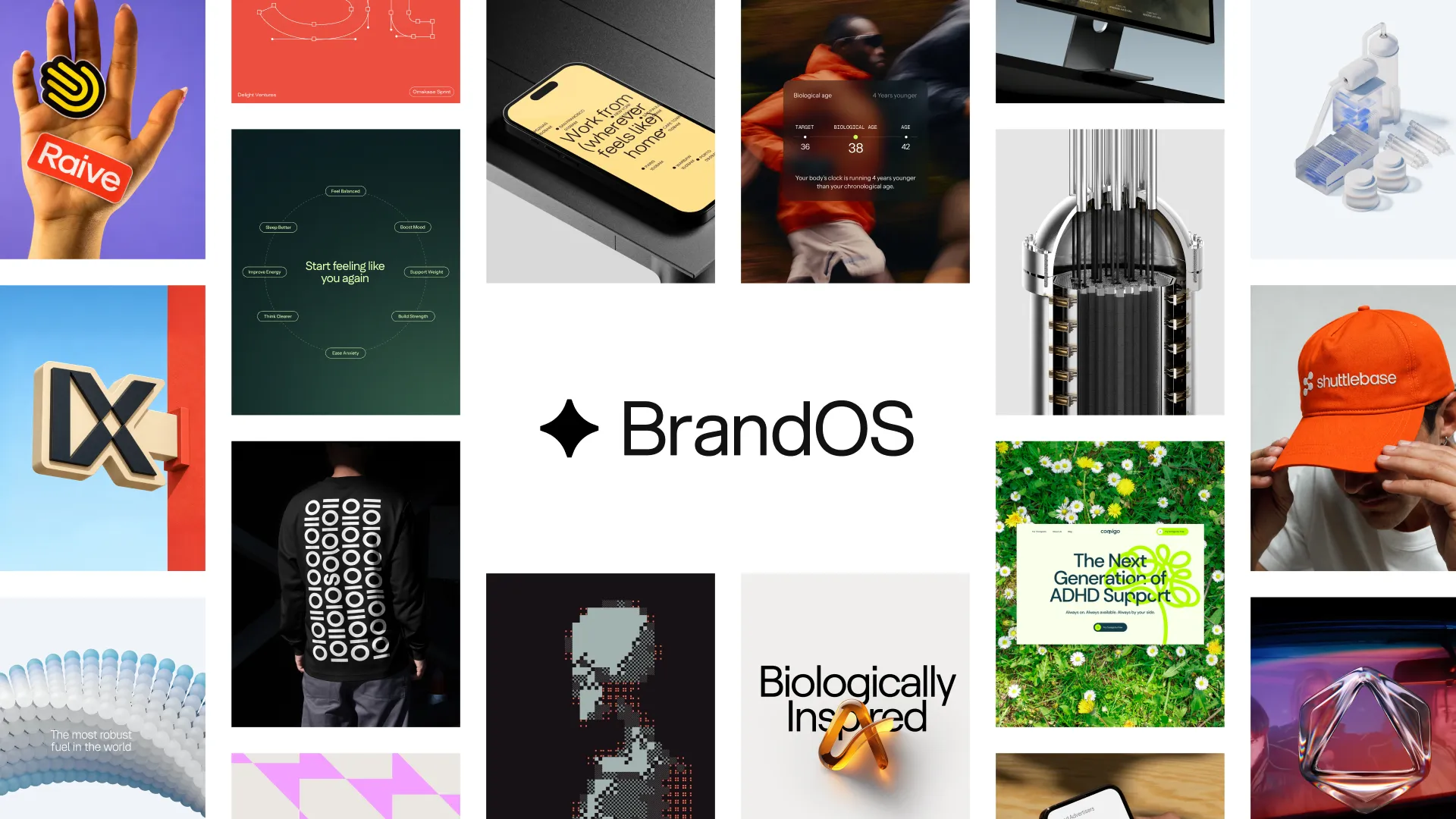
A brand book for people, a system for AI
A brand book explains the identity clearly. It shows the logo, typography, colors, imagery and principles that define the visual system.
But a brand book still requires interpretation.
A designer can look at a set of guidelines and understand the relationships between the pieces. They can judge how large a headline should be, how much space a composition needs, when an image feels wrong or when something technically follows the guidelines but still does not feel like the brand.
For someone without a design background, those decisions are much harder.
BrandOS works alongside the traditional brand book by translating more of those decisions into structured instructions that AI can understand.
Typography, color, spacing, layouts, imagery, writing and other behaviors are described much more explicitly than they would be in a normal brand guide.
The result is two versions of the same system. One helps people understand the brand. The other helps AI apply it.
Why this matters now
AI can already produce most of the everyday materials a company needs. A founder can make a landing page. A marketer can build a deck. A team can create social content without waiting for a designer.
The problem is that without enough context, AI tends to produce generic work. You can give it the correct logo, colors and fonts and still end up with something that has very little relationship to the brand itself.
That is because a visual identity is not just a collection of assets.
It is also the relationships between them: how typography is scaled, how pages are composed, how imagery is treated, how information is prioritized and hundreds of smaller decisions that designers usually make instinctively. We see it with our own work. A brand can launch well and still start to drift within months, not through any bad decision, just through many quick ones made without the context behind them.
Generic work rarely looks like a mistake. It just spends a little of the trust people have in you each time. BrandOS gives AI more of that context. It does not turn AI into a designer. It gives it better boundaries, so people without a designer sitting beside them have a much better starting point.
What BrandOS can help you make
BrandOS is built around the things teams already need to create regularly.
Website Pages
BrandOS contains rules for layout, typography, spacing, section relationships, imagery and other behaviors derived from the website and visual identity we designed.
That gives AI more than a visual reference. It gives it instructions for how the system should behave when creating new pages or sections.
Slides
Presentations are one of the most common places where brands begin to drift.
BrandOS gives AI the layout and typography logic needed to create new presentation material that begins much closer to the original design system.
Social posts
The same system can be used when creating announcements, product posts, statements and other recurring social content.
The goal is not to create endless new graphic design. It is to make everyday communication easier without starting from zero every time.
Documents
BrandOS can also provide the visual and verbal context for one-pagers, reports and other documents that sit somewhere between a presentation and a website.
Check work against the brand
Generation is only one side of the system. BrandOS can also review work that already exists.
A team can create something themselves, then give the result to an AI tool together with the BrandOS rules. The system can identify where the work has moved away from the brand and explain what should change.
That might be typography, color, spacing, imagery, layout or another rule within the system.
This matters because we do not expect every piece of brand communication to begin inside the same tool.
Someone may work in Canva. Someone else may use Figma. Another person may generate something directly with AI.
BrandOS gives those different workflows a common reference point. It catches the drift before it reaches anyone outside the company.
Use it with the tools you already use
We deliberately did not build BrandOS as another piece of software that teams have to adopt. Individual parts of BrandOS can be used with tools such as ChatGPT, Claude, Cursor and other AI products that can work from structured context.
As those tools change, the brand does not need to change with them. The important part is the underlying system.
A brand should still begin with judgment
BrandOS does not create the brand. It cannot decide what a company should stand for, what visual idea is right, which direction has meaning or which creative decision should be made in the first place.
Those decisions still come from people. BrandOS begins after that work has been done. That’s why every BrandOS starts from an identity we’ve made together with a company. It’s built from the decisions behind that brand, not filled in from a template.
Once the identity has been defined, it makes more of its logic explicit, structured and usable by the founders and teams who need to work with the brand every day, whether they have a designer on staff or not. A brand book often ends up in a folder. BrandOS is meant to be used every day, long after the design work is done.
We’ve started putting it to work with a few of the companies we work with. If we’ve worked together, ask us about yours. If we haven’t yet, we’d like to hear what you’re building.
AI makes it easier to create. BrandOS helps make sure everything you create stays true to the brand you have already built.