The creation barrier is the last thing standing between a billion people and making games.
Every platform that scaled on user-generated content did it by collapsing one specific barrier. YouTube collapsed production. TikTok collapsed distribution. Roblox collapsed the game-building itself, but only halfway. You still need a PC. You still need to learn scripting. Only 1% of Roblox users ever build anything. The other 99% just play.
Playabl collapses the last wall.
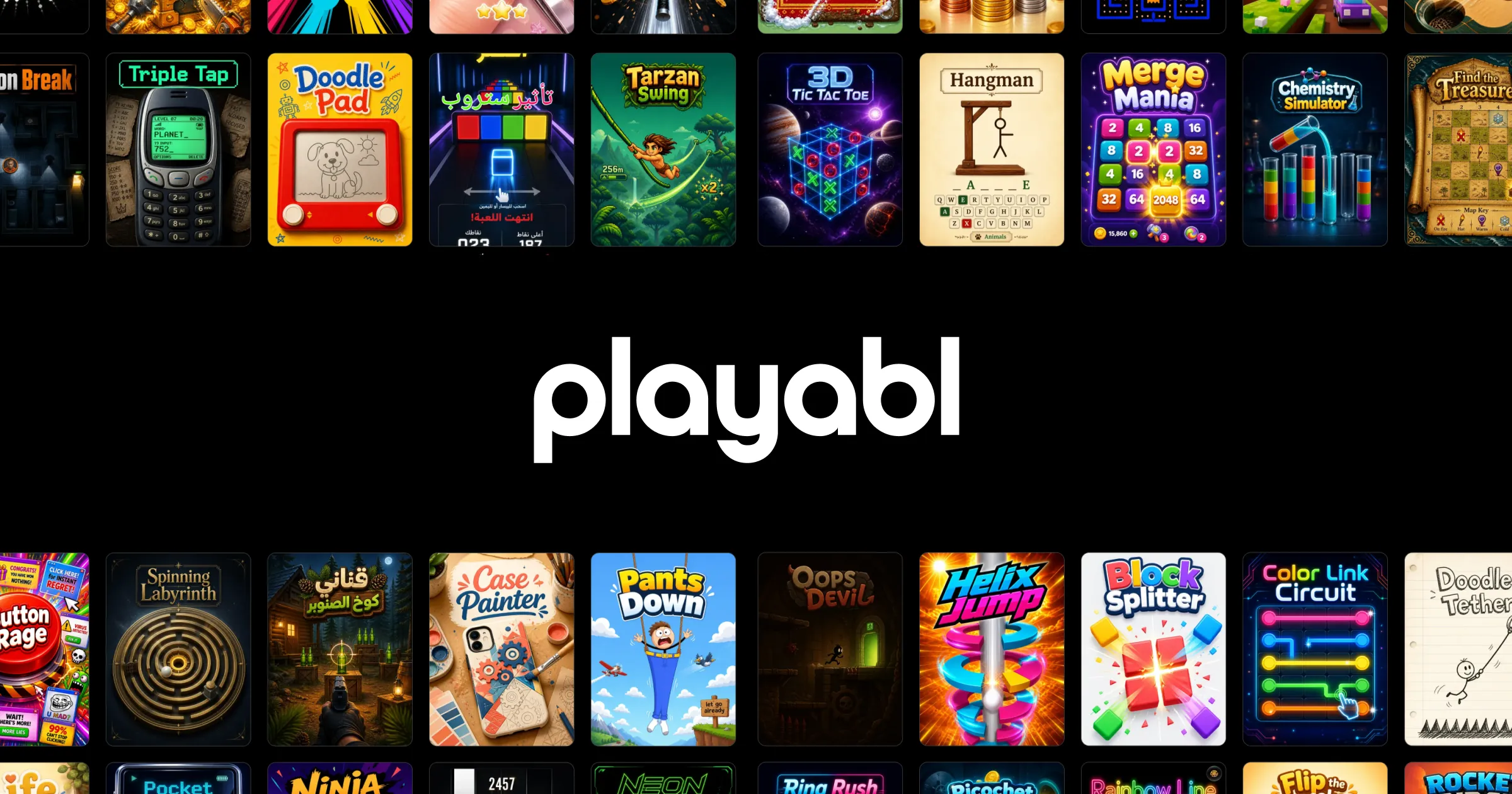
Describe a game in a sentence. The AI builds it. It goes live on a scrollable feed where the next person can play it, remix it, and post their version. No code. No studio. No install. The median mobile game retains 4% of players by day 7. Playabl games average 8%, built in seconds by people who have never shipped software. That number lands differently when you hold both facts at once.
What we saw
I first met Hamza at YC Design Day in April, where I was running design feedback sessions for the batch. He showed me what was then a prompt-to-play creation tool. Interesting. But what I noticed more than the product was how he talked about distribution. He wasn't thinking about features. He was thinking about how behavior spreads.
Six weeks later, Playabl was something different. The creation tool was still there, but it was now underneath a feed. Users hadn't been paying for the creator tool, but they were sharing playable links with their friends. Hamza followed the behavior. The product pivoted to match it.
That's the thing I look for and rarely see. Not a founder who builds what they imagined. A founder who builds what users actually do.

The compounding we care about
In its first six weeks, Playabl passed 7 million plays. Daily actives grew from a few hundred at launch to around 50,000, roughly 65x. Every day, players create thousands of new games, made by people who have never written a line of code. These are not launch-event numbers. The cohort curves compound week over week.
The engagement quality is what earns the comparison to TikTok, not the layout. 96% of visitors interact with what they see. D7 per-game retention beats three quarters of games shipped to the App Store. These are not metrics you manufacture with a press release. They come from a feed people actually return to.
Beyond the feed
The feed is the surface.
The team already knows what threatens it. Volume without direction kills engagement. A billion games means nothing if the right game never finds the right player. He is building a personalized discovery layer on top, one that uses code-level visibility into what makes each game work to understand what kind of play you actually enjoy, not just what genre you clicked. Roblox built recommendation on top of opaque game objects. Playabl generates the game. So it knows the game.
The monetization model that follows is different from anything in mobile. Brands don't buy interruptions. They build games on the platform's engine. The game is the ad. Interaction replaces impression. That changes the relationship between brand and audience entirely, and it runs on the same infrastructure the platform already has.
Hamza isn't thinking about this round. He's thinking about what happens when a billion mobile users stop being passive players and become the studios.
Why we invested
We have been backing founders before the evidence is undeniable since that is the only time the terms make sense and the relationship means something.
Hamza is a repeat founder. He and his co-founders previously built game modding tools that reached 5 billion views with zero marketing spend and $1.3M in revenue from Jordan. That is not a team learning how to find an audience. That is a team that already knows.
The growth rate since April is not something we manufactured. We watched it happen.
We're proud to be in this round alongside Amjad Masad, founder of Replit, and angels from Roblox, Google, and Meta.
The product is live at playabl.ai.